
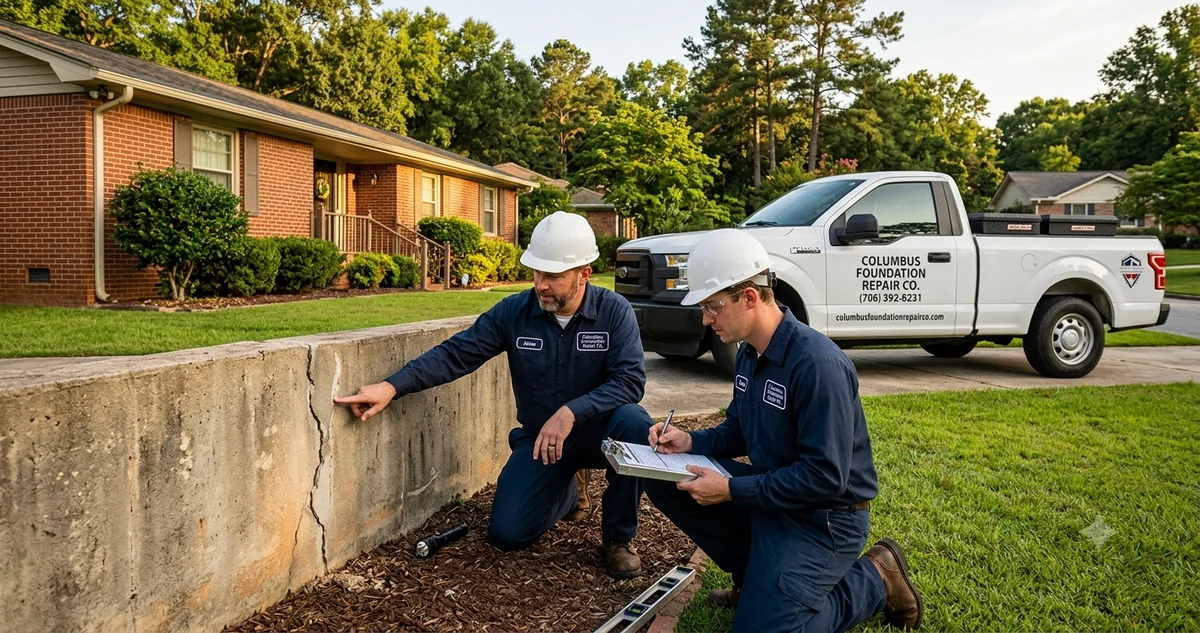
Why Do Basement Walls Bow in Columbus GA?
Bowed walls in Columbus are almost always caused by hydrostatic pressure — when the expansive clay soils around your foundation absorb rainwater and swell, pushing against your basement or crawl space walls with thousands of pounds of force per square foot.
Neighborhoods with clay-rich soil conditions, especially those near the Chattahoochee River floodplain, see the highest rates of wall bowing. The pressure builds gradually over years, which is why many homeowners don't notice until doors start sticking or cracks appear in the drywall above the basement.
Our approach is to first relieve the pressure by improving drainage around the foundation, then stabilize the wall permanently with carbon fiber reinforcement, wall anchors, or steel I-beams — depending on how much movement has already occurred.
What Are the Warning Signs of a Bowing Basement Wall?
The classic sign is a horizontal crack in the middle third of the wall — roughly waist height — that gets wider at the center and narrower at the ends. You might also see the wall curving inward (measure by placing a level vertically against it), cracks in the drywall on the floor above, or doors that stick at the top corner.
Catching a bowed wall early makes a massive difference. A wall that has moved less than two inches can often be stabilized with carbon fiber straps in a single day. Walls that have moved more require wall anchors or helical tiebacks. Left untreated, the wall can eventually collapse — and that repair involves full excavation and replacement.
How Do We Repair Bowed Walls in Columbus GA?
Every repair starts with a free inspection where we measure the bow, identify the cause, and check the footing and drainage. If the wall is structurally sound and the bow is under two inches, carbon fiber straps applied vertically every few feet can stop further movement permanently.
For moderate to severe bowing, we install wall anchor systems — steel plates on the interior wall connected to steel shafts driven through the wall and anchored in stable soil outside. The anchors are tightened gradually over time to pull the wall back toward its original position. Every repair includes improved drainage to prevent the problem from recurring.
| Repair Method | When It's Used | How It Works |
|---|---|---|
| Carbon fiber straps | Bow under two inches | Applied vertically every few feet — can stop movement in a single day |
| Steel wall anchors / helical tiebacks | Moderate to severe bowing | Steel plates and shafts anchored in stable soil, tightened gradually to pull the wall back |